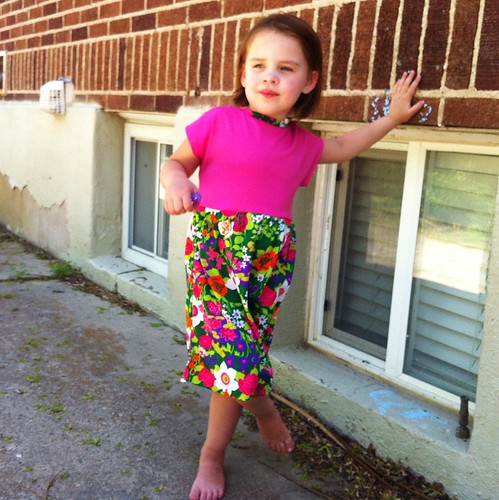
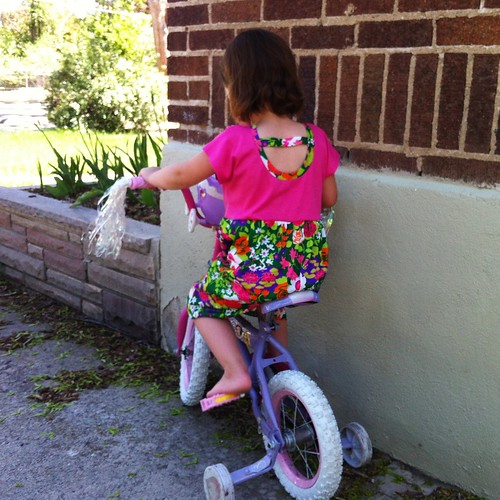
I almost forgot to post this! May has been an utterly wretched month and I'm glad it's over. And that's all I have to say about that.
I did a bit of sewing.
1) No Sew Tutu for Myra
2) Tote bag for Logan's class
3) Maria Denmark Kirsten tee for me
4) Sewing Cake Tiramisu dress for me
5) Simplicity 2377 top for Myra
6) Jalie 2908 jeans for me
7) Jalie 2105 leotard for Myra
8) Ottobre 03/2013-10 shorts for Logan
9) McCalls 2423 dress for Myra
10) Go To Patterns gift bags x3 for the kids' teachers
11) McCalls 2434 dress for Myra
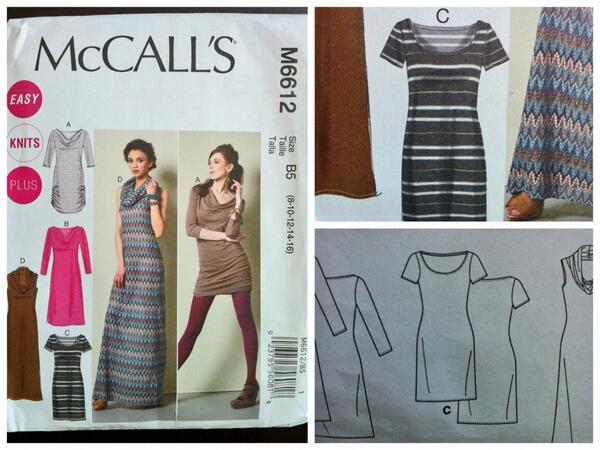
12) McCalls 6612 x2 for the Big 4 experiment
I am so behind on blogging, and I do apologize for that. I have lots of fun things to show you, including the results of my Big 4 experiment.
Anyway, as far as productivity goes, May was pretty average. I sewed 15 items, including a couple of bags - unusual for me. I sewed up 17.75 yards of fabric, but managed to acquire 29.5 yards. Stress shopping anyone? Yeah. I didn't sew any vintage or Burda patterns, but I did try the Maria Denmark Kirsten tee and made a Cake pattern and a couple of Jalies, so at least the Indie pattern companies were represented.
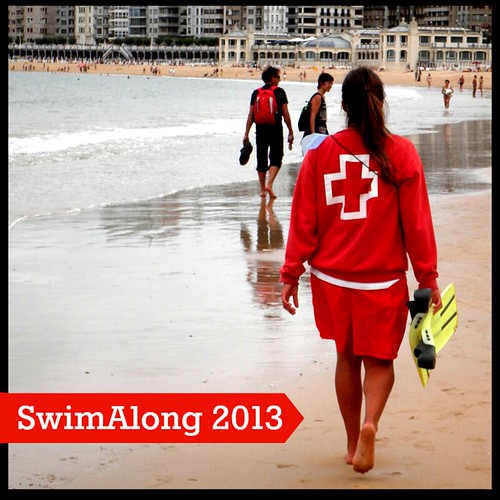
I have been really excited about the response to the SwimAlong that Leila and I are hosting. We're starting to see some pretty awesome swimwear shaping up. We still have lots to share with you this month, and we'll be getting pretty heavy into sewing techniques and tips. Stick around for the fun!
My other fun project this month is the Big 4 experiment. I've already sewn the two tops, but I still need to take some pictures. I really want this to be a fair comparison, so I'm waiting for a good photo opportunity, and a new camera that is coming my way. I've been really blown away by the response the original post had. So many of you are frustrated with the results you've had from the Big 4 patterns, but there are quite a few of you that also are happy with the fit, or are accustomed to the fit model and would have to relearn the adjustments you need if changes were made. There is a lot to talk about... Stay tuned!
Saturday, June 1, 2013
Friday, May 31, 2013
SwimAlong 2013: Swimwear notions and where to find them
We've got the fabric, but there are a few more specialized components we'll need to make a swimsuit. Obviously, this will be somewhat specific to your pattern, but there are a few things we'll all need.
Thread
I know - we're sewing so obviously we need thread, but there are a few types of thread that can really make your swimwear sewing professional grade. Naturally, you'll need regular general purpose thread for seaming. Do be sure that you choose a polyester thread and not cotton or silk. Polyester has the slight give and strength you'll need for sewing swimwear. Another type of thread I want to mention is wooly nylon, which is pictured above. This thread is unspun nylon filaments, and it s-t-r-e-t-c-h-e-s with your fabric. If you are using a serger, you can thread some or all of your threads with wooly nylon for a truly elastic seam. I generally put it in my loopers and Maxi-lock in my needles. You'll be blown away by how much this seam will stretch! You can also use it in the bobbin of your sewing machine, both for general seaming and for topstitching. It's particularly fabulous when you are using a twin needle. It really gives the stretch you'll need when sewing swimwear.
Elastic.
Pretty much no matter what swim pattern you are using, you're going to need some elastic. And swimwear elastic is put through a lot. It functions as an edge finish as well as holding the suit in the correct shape. It has to stand up to all the same environmental stresses that the suit fabric is exposed to, all while maintaining it's shape. If your elastic loses it's spring, you are going to be exposing body parts you may want to keep contained.
There are two major types of elastic used in swimwear. The most common is cotton knitted elastic that has been treated to be chlorine resistant. This product looks much like regular elastic, although it is commonly an off white color. It behaves much like regular knitted elastic, so it is easy to sew. It is generally labeled specifically as "swimwear" or "swim" elastic, so be sure to look for that. The other type is rubber elastic. This is my personal preference for sewing swimwear, but not everyone loves it. It is made out of rubber (hence the name) and behaves a bit like clear elastic, but is much sturdier. Since it is made of rubber it is naturally durable and chlorine/sun resistant. Some sewists have also had good luck using clear elastic for swimwear, but I personally find it flimsy and more difficult to apply.
Lining
Even if you just put in a bit of a crotch lining, you'll need some lining fabric. Although it is perfectly acceptable to line a swimsuit with self fabric, you'll be cooler and more comfortable in lighterweight lining fabric. You can purchase swimsuit lining at many fabric vendors that also sell spandex. It's much less expensive than the fashion fabric, and it typically only comes in a nude-ish color. Remember that lighter colored fabrics particularly are prone to becoming sheer when wet, so a fully lined suit will make you feel more confident that your suit really is covering the topic.
Another option, and one you'll see often in RTW suits, is Powernet (also called powermesh). This is a firm control fabric that acts like a sort of Spanx for your swimsuit. If you are concerned about jiggles or unsightly bumps, fully lining your suit with powernet can help control some of those things. It's also great used just in areas where you want a little extra support, like the bust area for a fuller busted woman.
Clasps and closures
While some suits are pull on or simply tie, many suits will require some sort of clasp or closure to stay securely on your body. These can be purely functional or decorative. There are as many clasp and closures out there as there are swimsuits.
Bra cups or other bust support
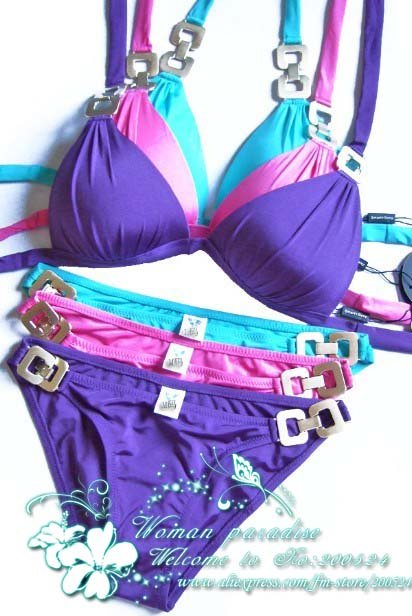
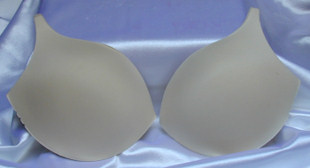
If you are sewing a woman's suit, chances are you will want some sort of additional support for the girls. Bra cups come in a variety of shapes and sizes and are easily inserted into a suit. Another option is to build a bandeau style bra with lining fabric and plush elastic. We've a future post dedicated specifically to this subject coming soon, so I won't go into it further, but suffice it to say, these products are available to the home seamstress.
So, where do you go to GET all this stuff? I find that vendors who cater to lingerie and swimwear sewing will have many of these products all in one place. I'm going to list a few of my favorite vendors of this type, but a google search for the product you need specifically will probably get you there as well.
SewSassy - This is absolutely my favorite source for my lingerie and swimwear sewing needs. They've been in business since they 80s and they really know their stuff. Don't let the archaic website put you off though. It can be a little tricky to find what you need, but the search is worth it. They even have Powernet.
Cleaner's Supply - It's a little random, but this site has amazing prices on tailoring supplies like thread and clasps/closures. They even have bra cups in a limited size range. Shipping is $4 flat rate and crazy fast. I generally get my order in 2-3 days.
Bra-makers Supply - Obviously they specialize in lingerie supplies, but they have a fairly comprehensive selection of cups, wire and even swim elastics.
Etsy - Etsy is one of my favorite places to find one of a kind notions. Interesting clasps, decorative elastics or lace and even bra making supplies can all be found here.
So, have you found a place that isn't on my list? Please share in the comments!
| Image source |
I know - we're sewing so obviously we need thread, but there are a few types of thread that can really make your swimwear sewing professional grade. Naturally, you'll need regular general purpose thread for seaming. Do be sure that you choose a polyester thread and not cotton or silk. Polyester has the slight give and strength you'll need for sewing swimwear. Another type of thread I want to mention is wooly nylon, which is pictured above. This thread is unspun nylon filaments, and it s-t-r-e-t-c-h-e-s with your fabric. If you are using a serger, you can thread some or all of your threads with wooly nylon for a truly elastic seam. I generally put it in my loopers and Maxi-lock in my needles. You'll be blown away by how much this seam will stretch! You can also use it in the bobbin of your sewing machine, both for general seaming and for topstitching. It's particularly fabulous when you are using a twin needle. It really gives the stretch you'll need when sewing swimwear.
| Image source |
Pretty much no matter what swim pattern you are using, you're going to need some elastic. And swimwear elastic is put through a lot. It functions as an edge finish as well as holding the suit in the correct shape. It has to stand up to all the same environmental stresses that the suit fabric is exposed to, all while maintaining it's shape. If your elastic loses it's spring, you are going to be exposing body parts you may want to keep contained.
| image source |
| Image source - be sure to check this one out - awesome! |
Even if you just put in a bit of a crotch lining, you'll need some lining fabric. Although it is perfectly acceptable to line a swimsuit with self fabric, you'll be cooler and more comfortable in lighterweight lining fabric. You can purchase swimsuit lining at many fabric vendors that also sell spandex. It's much less expensive than the fashion fabric, and it typically only comes in a nude-ish color. Remember that lighter colored fabrics particularly are prone to becoming sheer when wet, so a fully lined suit will make you feel more confident that your suit really is covering the topic.
| image source |
Clasps and closures
While some suits are pull on or simply tie, many suits will require some sort of clasp or closure to stay securely on your body. These can be purely functional or decorative. There are as many clasp and closures out there as there are swimsuits.
| image source |
If you are sewing a woman's suit, chances are you will want some sort of additional support for the girls. Bra cups come in a variety of shapes and sizes and are easily inserted into a suit. Another option is to build a bandeau style bra with lining fabric and plush elastic. We've a future post dedicated specifically to this subject coming soon, so I won't go into it further, but suffice it to say, these products are available to the home seamstress.
| image source |
SewSassy - This is absolutely my favorite source for my lingerie and swimwear sewing needs. They've been in business since they 80s and they really know their stuff. Don't let the archaic website put you off though. It can be a little tricky to find what you need, but the search is worth it. They even have Powernet.
Cleaner's Supply - It's a little random, but this site has amazing prices on tailoring supplies like thread and clasps/closures. They even have bra cups in a limited size range. Shipping is $4 flat rate and crazy fast. I generally get my order in 2-3 days.
Bra-makers Supply - Obviously they specialize in lingerie supplies, but they have a fairly comprehensive selection of cups, wire and even swim elastics.
Etsy - Etsy is one of my favorite places to find one of a kind notions. Interesting clasps, decorative elastics or lace and even bra making supplies can all be found here.
So, have you found a place that isn't on my list? Please share in the comments!
Wednesday, May 29, 2013
SwimAlong 2013: Fabric for swimwear and where to find it
Swimwear fabric has a pretty specific job to accomplish. It has to be sturdy enough to withstand constant stretching and movement, not to mention the effects of chlorine, sand and sun.
It also has to be soft and stretchy, with great recovery so that it will fit well and not sag or bag with wear. Ideally, it should also be attractive, in a print or color that flatters you.
Fortunately for us, we live in the age of Lycra. Blended with other fibers, we can have that perfect fabric; soft, stretchy and with great recovery. Add to that the synthetic fiber, Nylon and you also have a chlorine resistant, color-fast fiber that is perfect for swimwear. You'll generally find it labelled "Spandex" even though in actual fact the spandex (the generic name for Lycra) content of the fabric is probably between 10 and 20%.
When you are shopping for your spandex fabric for swimwear, there are a few things you want to look for. Not all fabrics that contain spandex will be suitable for swimwear. Ideal swimwear fabric should be a blend of nylon and spandex (lycra) and should stretch in all directions. This last part is tricky as some vendors will label this 4-way stretch and others will say 2-way stretch. When in doubt, call or do not buy. Fabric that only stretches in the horizontal direction will not make a comfortable swimsuit.
I thought it might help to peek at a screenshot from a common spandex fabric vendor, just to see what we're looking for. Click the picture to biggify. The arrow points to all the vital information about this fabric. The fiber content is 80% nylon and 20% spandex, which is great. You can go as low as 10% spandex and still have a suit that fits and moves with you. The next line shows the fabric weight. The bigger the number, the thicker and heavier the fabric is. Personally, I find that heavier fabrics are a bit easier to sew since they're more stable and curl less, so if you're new to sewing spandex, go for an 8 oz weight. Anything less than about 5 oz weight is likely to be sheer, so be cautious of the lower numbers. The final thing to check is to be sure that the fabric stretches in all directions. You can see that Spandex World specifies that this fabric has 4-way stretch, so I can purchase with confidence.
If you are on Twitter and would like to chat with fellow sewists (including me) about swimwear fabrics, we'll be having a chat on Friday, May 31st at 4PM Eastern Time. Get all the info (including how to join us) here.
So, now that you know what you are looking for, where do you go? There are quite a few online vendors that specialize in swim and activewear fabric, so I'll introduce you around. I haven't shopped at ALL of these vendors, but I'll let you know my experience with those I have.
Spandex World/Spandex House - I lump these together because they really are very similar. Both are located in the garment district, and both carry a whole lot of good quality spandex fabric at reasonable prices. I personally do my business at Spandex World, so I can tell you that I have always had a good experience shopping with them, but Spandex House customers say the same.
SpandexByYard.com - This company specializes in commercial sales of sporting grade spandex, but they do sell by the yard to the home sewist as well.
Designer Alley Fabrics - This West Coast based company specializes in selling stretch fabrics to the small designer. They have lots of interesting prints and stretch trims.
These are just a few of the numerous other online vendors that specialize in spandex fabrics. A google search for "spandex fabric" may turn up something that suits you as well. Be sure you type in the word "fabric" if you search though. A search for just "spandex" may be more educational that you want...
Specialty vendors aren't your only option though. Many of the larger online vendors also offer swimwear fabric, but you do have to be more cautious about checking to be sure it is the quality you are looking for. When in doubt, call or don't buy. A few vendors that are worth checking are:
Fabric.com - Their prices for basic spandex are a little higher than the speciality places, but the free shipping can even things out. One down side is that they don't generally publish fabric weights, so you may not be getting what you think, and they can be hard to contact, so you may not be able to ask.
The Fabric Fairy - This vendor specializes in stretch fabrics, but has a nicely curated selection of swimwear fabrics, including microfiber fabric for board shorts, which is notoriously tricky to find. Their customer service is top notch.
Cali Fabrics - This is a relative newcomer to the online scene and their selection of swimwear fabrics is small, but of good quality and the customer service is very personal.
Chez Ami - For those who have never heard of them, Chez Ami specializes in personalized, boutique style children's clothing, but also offer their fabrics for sale. Their Knit Tactel Jersey is one of my absolute favorite swim fabrics to sew. It has almost no curl, is not as slick as typical spandex and is heavier weight. The down side is that they only sell their fabrics in 2 yard cuts, and the prints skew toward the more juvenile. Worth checking though, as their prices are excellent for the fabric quality.
Michael Levine AKA Low Price Fabric - This LA institution has a large variety of fabrics, including an excellent selection of swimwear. There isn't as much information on their website as I might like, but their customer service is great, so just give them a call if you are in doubt.
Obviously, this list is no where near comprehensive, particularly for those who are not in the US. I'd love it if you would include your favorite source for swim fabrics in the comments, particularly if you are overseas. We always need more places to buy fabric, right??
![]() |
| Image source |
| Image source |
| Image source |
| Like this print? Get it here. |
If you are on Twitter and would like to chat with fellow sewists (including me) about swimwear fabrics, we'll be having a chat on Friday, May 31st at 4PM Eastern Time. Get all the info (including how to join us) here.
| Image source |
Spandex World/Spandex House - I lump these together because they really are very similar. Both are located in the garment district, and both carry a whole lot of good quality spandex fabric at reasonable prices. I personally do my business at Spandex World, so I can tell you that I have always had a good experience shopping with them, but Spandex House customers say the same.
SpandexByYard.com - This company specializes in commercial sales of sporting grade spandex, but they do sell by the yard to the home sewist as well.
Designer Alley Fabrics - This West Coast based company specializes in selling stretch fabrics to the small designer. They have lots of interesting prints and stretch trims.
These are just a few of the numerous other online vendors that specialize in spandex fabrics. A google search for "spandex fabric" may turn up something that suits you as well. Be sure you type in the word "fabric" if you search though. A search for just "spandex" may be more educational that you want...
| Image source |
Fabric.com - Their prices for basic spandex are a little higher than the speciality places, but the free shipping can even things out. One down side is that they don't generally publish fabric weights, so you may not be getting what you think, and they can be hard to contact, so you may not be able to ask.
The Fabric Fairy - This vendor specializes in stretch fabrics, but has a nicely curated selection of swimwear fabrics, including microfiber fabric for board shorts, which is notoriously tricky to find. Their customer service is top notch.
Cali Fabrics - This is a relative newcomer to the online scene and their selection of swimwear fabrics is small, but of good quality and the customer service is very personal.
Chez Ami - For those who have never heard of them, Chez Ami specializes in personalized, boutique style children's clothing, but also offer their fabrics for sale. Their Knit Tactel Jersey is one of my absolute favorite swim fabrics to sew. It has almost no curl, is not as slick as typical spandex and is heavier weight. The down side is that they only sell their fabrics in 2 yard cuts, and the prints skew toward the more juvenile. Worth checking though, as their prices are excellent for the fabric quality.
Michael Levine AKA Low Price Fabric - This LA institution has a large variety of fabrics, including an excellent selection of swimwear. There isn't as much information on their website as I might like, but their customer service is great, so just give them a call if you are in doubt.
Tuesday, May 28, 2013
The Big 4 Experiment
In the last several days, there has been a flurry of activity centered around a problem that we all have. If you've ever sewn a Vogue, Butterick, McCalls or Simplicity pattern, you'll probably recognize what I'm talking about. Did your project turn out the way you expected it? Did it look like the pattern envelope? If it did, how much did you have to alter the pattern to make it look that way?
Robin, Shams, Anne and Barbara have all posted eloquently on this subject. The Big 4 uses an outdated fit paradigm, and complicates matters by adding significant amount of ease to their patterns. The pattern instructions use outmoded methods, when they make sense at all. As a result, choosing a size is pretty much total guesswork, combined with a little advanced math and geometry. The end result is based much more on the experience level of the sewist, and not on the quality of the pattern. While I don't think I can add much to the wise words penned by the preceeding bloggers, I'd like to add a little experiment, and I hope that some of you will try this out yourself.
I'm going to start with a basic knit top pattern. This one is described as close fitting. We'll see. I'm going to approach this project from the perspective of the beginning sewist. She's not had any formal sewing training, but she wants to learn, or maybe she's a quilter who wants to sew clothing. (I'm not trying to be gender biased here - I just so happen to be a she. Boys sew, too.) Either way, she's found herself at her local fabric and craft store, picked up a pattern and some jersey and set out to teach herself to sew. I'm going to cut and sew this pattern as McCalls instructs, basing the size on my full bust and using the pattern instructions to construct my top. When that is finished, I'm going to make the top my way, using my "typical" Big 4 size and alterations, and constructing the top using modern knit construction methods. Then I'll share the tops with you.
If this sounds like a fun experiment to you, I hope you'll try it out yourself as well. I'd love to see some change happen, and I think that if we get a lot of voices to make a big noise, maybe we can find the ear of the powers that be at the Big 4. Are you in??
Robin, Shams, Anne and Barbara have all posted eloquently on this subject. The Big 4 uses an outdated fit paradigm, and complicates matters by adding significant amount of ease to their patterns. The pattern instructions use outmoded methods, when they make sense at all. As a result, choosing a size is pretty much total guesswork, combined with a little advanced math and geometry. The end result is based much more on the experience level of the sewist, and not on the quality of the pattern. While I don't think I can add much to the wise words penned by the preceeding bloggers, I'd like to add a little experiment, and I hope that some of you will try this out yourself.
I'm going to start with a basic knit top pattern. This one is described as close fitting. We'll see. I'm going to approach this project from the perspective of the beginning sewist. She's not had any formal sewing training, but she wants to learn, or maybe she's a quilter who wants to sew clothing. (I'm not trying to be gender biased here - I just so happen to be a she. Boys sew, too.) Either way, she's found herself at her local fabric and craft store, picked up a pattern and some jersey and set out to teach herself to sew. I'm going to cut and sew this pattern as McCalls instructs, basing the size on my full bust and using the pattern instructions to construct my top. When that is finished, I'm going to make the top my way, using my "typical" Big 4 size and alterations, and constructing the top using modern knit construction methods. Then I'll share the tops with you.
If this sounds like a fun experiment to you, I hope you'll try it out yourself as well. I'd love to see some change happen, and I think that if we get a lot of voices to make a big noise, maybe we can find the ear of the powers that be at the Big 4. Are you in??
Monday, May 27, 2013
McCalls 2434 dress
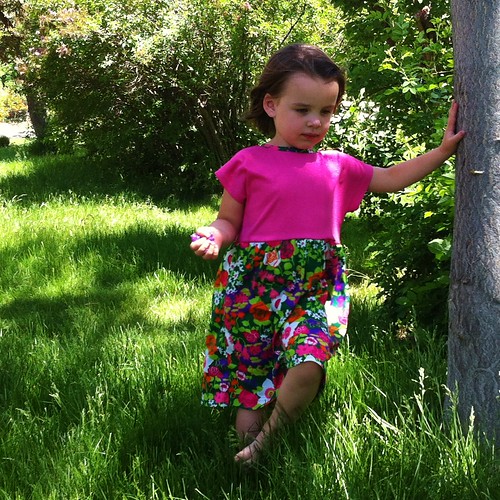
I made a maxi dress last year out of some completely awesome floral and frog printed Qiana. I love this dress and wear it constantly. Every time I wear it, Myra asks me to make her one, but I only had a tiny scrap of the Qiana left. What's a sewing Mommy to do?
Fortunately, my mother had a scrap of pink sparkle jersey (left over from this wrap tee) that was a perfect match for the dark pink flowers in the print. The dress is not quite maxi length, as I was severely short on fabric, but Myra's a pretty busy girl and I think a maxi would slow her down.
The pattern I used was McCalls 2434, published in 1986. It's drafted for woven fabrics, and the neckline is finished with a facing. Since I was using a knit, I decided to finish the neckline with a band of the skirt fabric.
All the action in this pattern is in the back. The neckline is low and scooped, with a strap across at the shoulder level. I love how sweet this looks. I think that since the dress is unfitted, it escapes any "sexy" overtones and just looks girly. The pattern also offers a square and vee neck option in back, which are also very cute.
My copy of the pattern is a size 5, which matched Myra's measurements. Since it is meant to be a woven, pull over dress it is quite loose on her. I could probably take out some ease, but I think it works as is for a simple summer play dress. I did alter the pattern by lengthening the bodice 2 inches. It is drafted for the seam to fall under the bust, which has a very juvenile look, almost babyish. I knew Myra wouldn't go for that, so I compared the length to the Skater Dress bodice and adjusted accordingly.
Myra is very pleased to finally have her own froggie dress to match mine. It passed all the playtime tests, and it's even bike friendly! It will definitely be a summer staple this year.
Fortunately, my mother had a scrap of pink sparkle jersey (left over from this wrap tee) that was a perfect match for the dark pink flowers in the print. The dress is not quite maxi length, as I was severely short on fabric, but Myra's a pretty busy girl and I think a maxi would slow her down.
The pattern I used was McCalls 2434, published in 1986. It's drafted for woven fabrics, and the neckline is finished with a facing. Since I was using a knit, I decided to finish the neckline with a band of the skirt fabric.
All the action in this pattern is in the back. The neckline is low and scooped, with a strap across at the shoulder level. I love how sweet this looks. I think that since the dress is unfitted, it escapes any "sexy" overtones and just looks girly. The pattern also offers a square and vee neck option in back, which are also very cute.
My copy of the pattern is a size 5, which matched Myra's measurements. Since it is meant to be a woven, pull over dress it is quite loose on her. I could probably take out some ease, but I think it works as is for a simple summer play dress. I did alter the pattern by lengthening the bodice 2 inches. It is drafted for the seam to fall under the bust, which has a very juvenile look, almost babyish. I knew Myra wouldn't go for that, so I compared the length to the Skater Dress bodice and adjusted accordingly.
Myra is very pleased to finally have her own froggie dress to match mine. It passed all the playtime tests, and it's even bike friendly! It will definitely be a summer staple this year.
Labels:
dress,
girls,
McCalls 2434
Subscribe to:
Posts (Atom)