Showing posts with label SwimAlong. Show all posts

Saturday, June 29, 2013

SwimAlong 2013: Board Shorts

I know the SwimAlong has officially ended, but summer hasn't! I'm sure I'm not the only one still sewing swimwear, so we'll just all keep going!
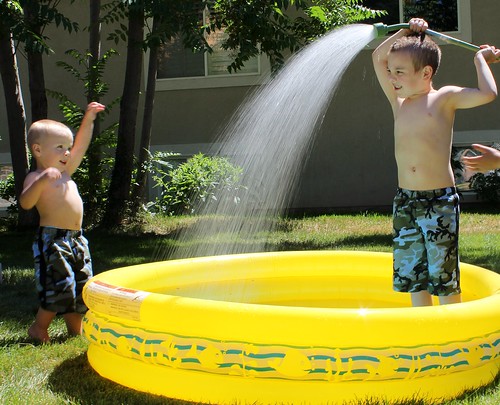
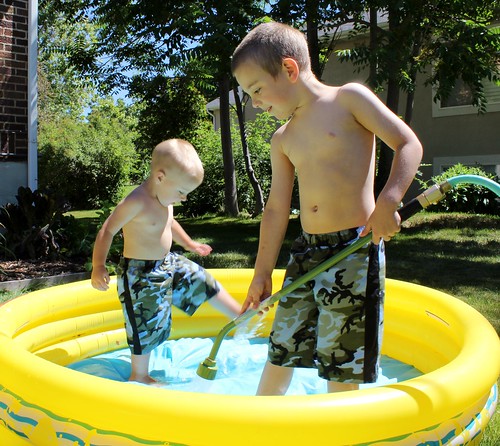
Poor Logan was wearing swim trunks at least 2 sizes too small. And while Duncan has two pair of hand-me-down trunks that fit him OK, they aren't great. So I decided to sew up matching board shorts for my boys, while they'll still let me dress them alike.
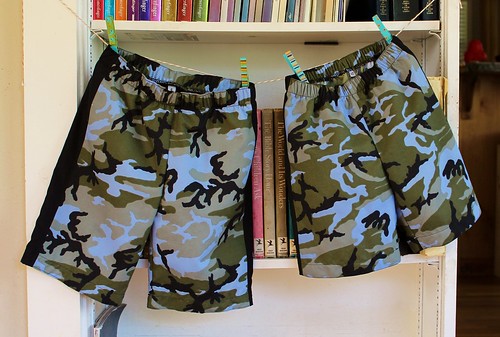
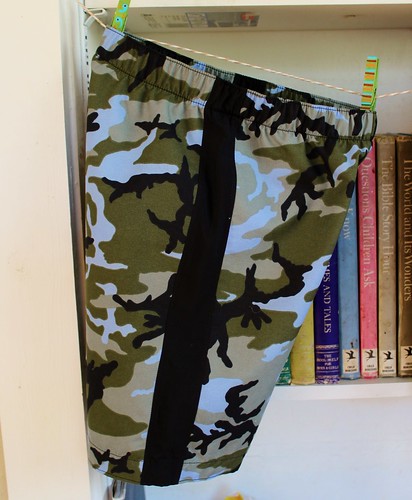
The boys are in two different size groupings (Logan is a 116 and Duncan wear a 92), so I couldn't use the same pattern. Instead, I just chose two basic elastic waist shorts patterns and styled them the same way. I eliminated all pockets and separate waistbands, and for Duncan's added a strip of fabric at the side seam to match the one on Logan's.
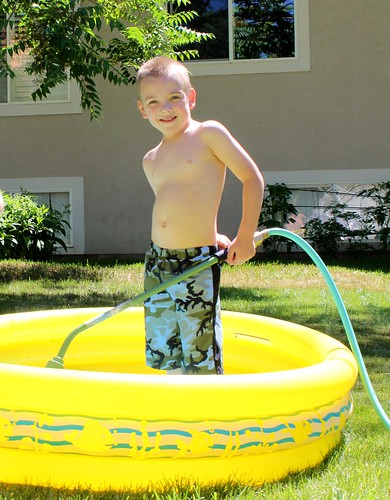
Logan's shorts are from the 03/2012 issue of Ottobre, model # 10. I've made them for him before, twice in fact, and he wears them regularly. Although these are drafted for a knit fabric, I knew they had sufficient ease to work in a woven. I did omit the pockets and added a casing for the waist, rather than a separate knit waistband.
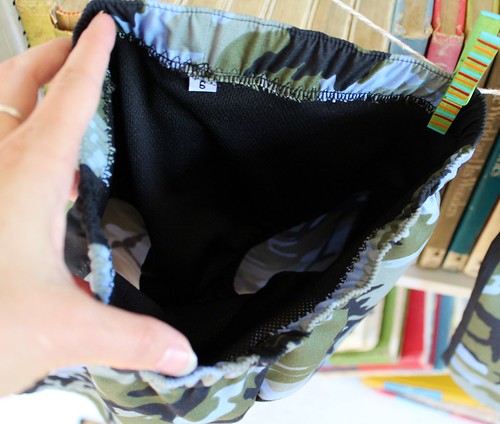
Logan's shorts also got a swimshorts style lining. This was so easy to add! I used Kitschy Coo's Boy Cut Brief pattern, since it only has side seams. The fabric I used is an athletic mesh, like you might see in lightweight running jerseys. I elasticated the leg openings with swim elastic, just like a regular swimsuit, and stitched the waistline to the top edge so that it was caught in the casing stitching. Logan says it is comfortable and that these are his favorite shorts. Yay!
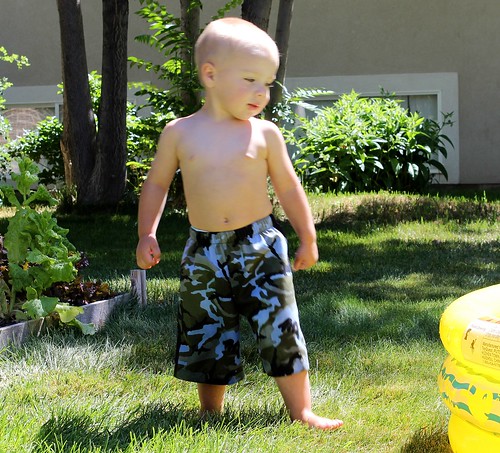
For Duncan, I used the 03/2006 issue of Ottobre. There is a series of shorts in that issue from the same block, one of which (#10) has a separate hem band. I used that version, omitting the hem band and hemming at the seam level, to make a shorter pant. As you can see, these are plenty long, so I'm glad I shortened them! Again, I omitted the pockets and added the side seam band. Since Duncan is still wearing swim diapers, I didn't include a lining, so these were even easier to sew.
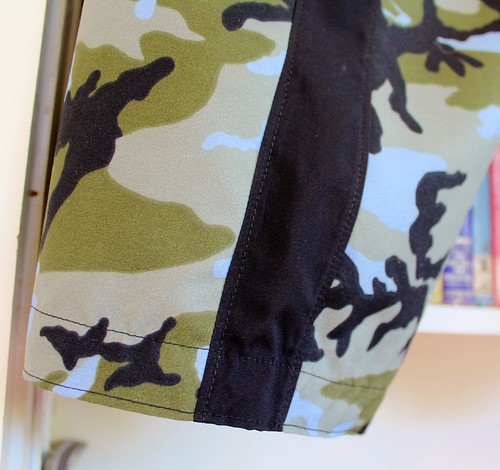
I noticed that the boys' RTW trunks have tons of topstitching, so I jazzed these up a little with topstitching down the side stripe, as well as a double line of stitching at the hem, which I echoed at the waistband. This had the added benefit of taming the somewhat unruly microfiber poly fabric I used.
Both shorts are made of polyester microfiber "board shorts" fabric from RockyWoods.com. (The link takes you right to the board shorts page.) This fabric is exactly like the fabric you see in RTW shorts and I was very pleased with it overall, but it wasn't the easiest to sew. 
There are a few things that can help make  it easier. The first is to make sure you use a sharp, fine point needle. I used a Microtex needle in a 70/10 size. This has a very fine point, which is perfect for punching through this densely woven fabric, without puckering or causing pulls.
The other important tip I have is to be sure you press very well. Do test first to get the optimal heat setting on your iron. This is polyester and you can melt it. Use the highest heat you can without damaging the fabric, and use steam. Be sure to press each seam both flat and open or to one side. You also want to be very diligent about finishing your seams. This stuff is very ravelly, and it will be subjected to a lot of stress. You don't need a serger (although that is a quick and easy option if you have it), just finish the edges with a 3-step zigzag or use french seams.
Despite the vagaries of the fabric, these whipped up quickly and the boys both like them. I know they'll both get a ton of use. If you're thinking about dipping your toe in the swimwear sewing pool, board shorts are an easy and fun place to start!

Wednesday, June 26, 2013

SwimAlong 2013: Strut your stuff!


Hey SwimAlong - ers! We're coming to the end of our series, but that doesn't mean you should stop sewing! I hope you'll continue to use the resources we've collected to make your swimwear sewing uncomplicated and fun.
Now it's time for those of you who have sewn up some fabulous swimwear to strut your stuff. Link up your pics or blog posts here and show us all what you've made! Since I know that many of us (myself included!) are still working on our suits, I'm going to leave the linky party open all summer. We'll close the links on the first of September. If you've sewn multiple items, please feel free to link them all. We love the inspiration!

Friday, June 21, 2013

SwimAlong 2013: Swim Coverups

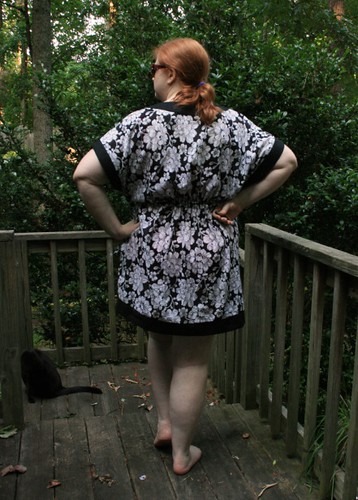
I'm so thrilled to have LadyKatza of Peanut Butter Macrame here today. If you don't know her already, you are in for such a treat! She is an amazing lady and a very gifted sewist. She has an incredible talent for blending vintage and modern styles absolutely seamlessly. She's here today to share with us the perfect complement to your gorgeous new swimsuit - a chic and stylish beach coverup. 

Howdy y’all! I’m so happy I can share with you this nifty little cover-up and that Katie was kind enough to ask me to do this, even though I’m probably late. I do things last minute ALL THE TIME.  So, the pattern is a free download from fabric.com, you can get it here. It’s basically a kaftan with contrasting trim and straight forward directions. I do want to share with you a few things I felt needed to be clarified and small tweaks to the pattern. **Important** Almost all seam allowances are 3/8 of an inch.
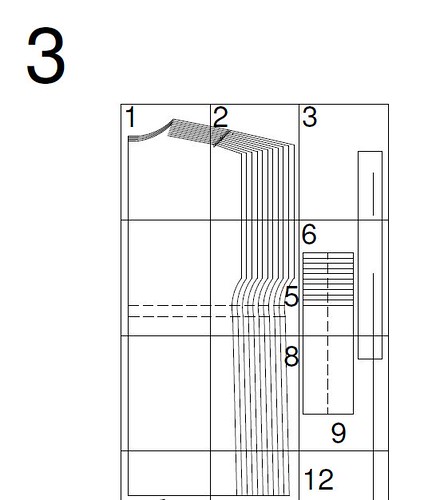
First off you want to go with your hip measurement.  This is essentially a rectangle with some elastic and ties for shaping, which works very well for a semi-sheer cotton or linen. The kimono styling of the sleeves means you really don’t need to make adjustments. Since this is a PDF pattern from an indy company, I DO recommend looking at the layout sheet, it looks like this:
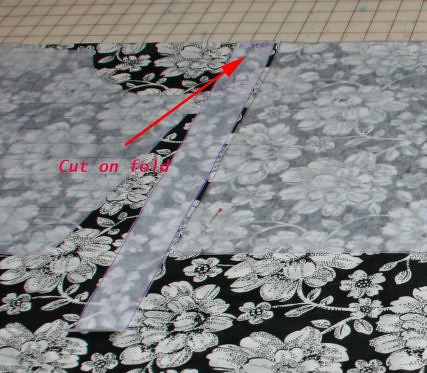
The other thing I recommend is not going strictly by the layout you are shown in the pattern, for one, the piece that is used as the elastic channel is cut on a fold, or it needs to be doubled in length if you are not going to cut on a fold.
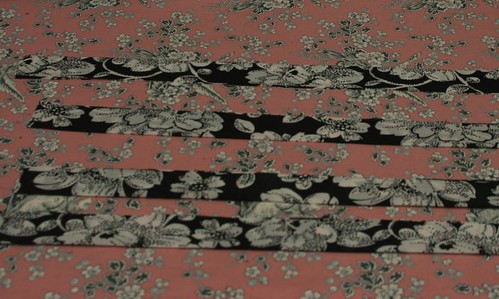
Don’t forget that your neckband, arm band, and hem band are all going to be from a contrasting fabric. My main fabric seen above is a cotton lawn, I used a plain black cotton lawn as my contrast.
The directions call for interfacing the arm bands and hem bands but since they are doubled over, I did not feel the need for this. I only interfaced the neck band, which is actually two pieces that are sewn together, the front V and the back arch.
I highly recommend the interfacing from FashionSewing Supply, by the way, it’s better than anything else I’ve used.
Fuse the separate neck pieces first, then sew them together as the directions show.  The next bits you want to sew are the tie ends, arm and hem bands.
The tie ends are long rectangles, iron them in half right sides together, sew one end and the long side, leaving the other small end open so you can turn them right side out. 
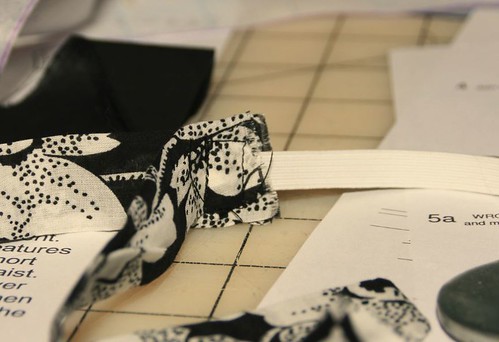
Use a pin to pull out the corners and press. Then you will take a 3/8 inch wide piece of elastic that is a couple inches shorter than your back width, sandwich the elastic between two ties at each end and sew yourself a little square. Then set them aside.
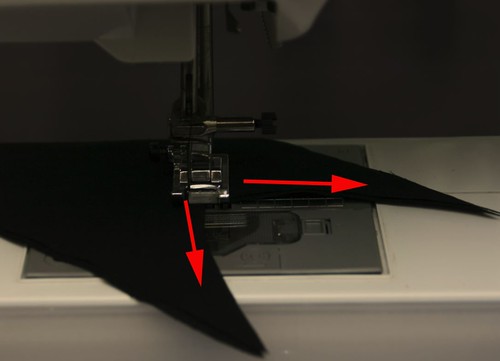
The arm bands have a dovetail shape to them for the underarm. When sewing them I suggest starting from the middle and sewing outward, this will give you a cleaner point.
Once the two pieces are sewn you will want to fold them in half and press. Be sure to clip the center point and press seams first.
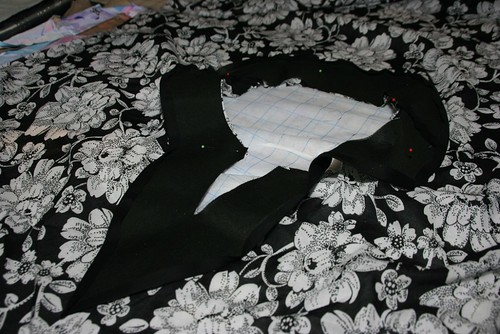
Once all the small pieces are done you will sew the shoulders together of the two main kaftan pieces, then press the outside edges of the neck contrast in by 3/8 of an inch. Next, pin and sew the neck contrast, right side down on the wrong side of the kaftan fabric, shown here:
You will then want to flip the band to the RIGHT side of the kaftan and press flat. When turning you can use a pin to pull the corner out to a sharp point.  
Topstitch all the way around the outside edges where you should have already pressed under.  Once that is done sew up the side seams of the kaftan and attach the arm and hem bands as shown in the PDF instructions.  Next I put the kaftan on and marked where I wanted the elastic channel to go, pinned it in  place and then topstitched it down. The instructions show you how to press the elastic channel before topstitching.
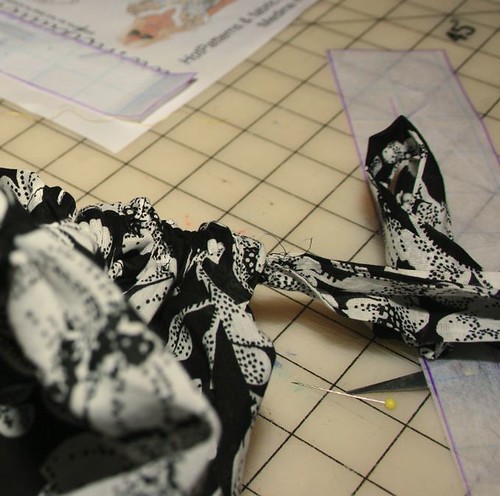
Here is the elastic channel sewn down.
I use this nifty notion that has a slide grip for threading elastic or ties.
And here is one side pulled all the way through. Put the kaftan on at this point and tie the ties into a bow in the most comfortable place for you. VIOLA! Beach cover up.


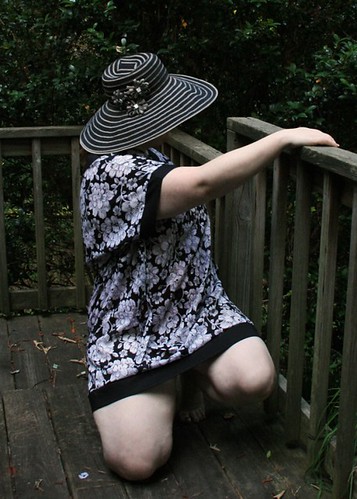
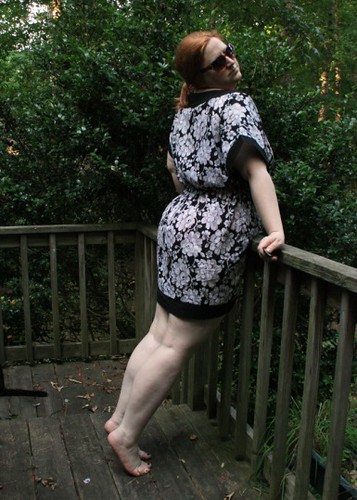
Alright folks, grab your sunscreen, hats, and beach towel and head on out. Now you can lounge fabulously while the kids wear themselves out in the water. Cheers!

Seriously, how gorgeous is she?? I love how easy, breezy and still completely fabulous this is. I need one! And also a fabulous hat. Be sure to check out the lovely coverup she made for her daughter as well. So sweet! Thank you for sharing it with us, LadyKatza!

Wednesday, June 19, 2013

SwimAlong 2013: Tips for a professional finish

Today I get a chance to introduce you to an amazing lady, whose swimwear sewing has been an inspiration to me for many years. I can't imagine that you haven't already come across her work in the blogosphere, so I hope you'll make Sarah of Musings of a Seamstress welcome. She's going to share with us some of her professional grade tips for sewing your swimwear. Read on, and fear elastic no more!

I want to thank Katie and Leila for hosting this SwimAlong and asking me to write a guest post. I wanted to share a couple of different ways to add elastic to your suit and a few other tips I have picked up along the way. I know this has been mentioned on the Twitter #FabricChats and on a few other blogs, but I think this is the most important thing when sewing swimwear (or any knit for that matter) and is worth repeating again. Are you ready?!? Okay, here it goes... Use bulky nylon thread, also called woolly nylon, on your bobbin! Go ahead, write that down, I'll wait. Why is it so important? Bulky nylon provides enough give when sewing stretchy fabrics that you should not be able to snap your threads when stretching it. They do sell it at Jo-Ann's in a variety of different colors, although it can be a bit pricey. I have not really shopped around for it online, so if you find it less expensive let me know! As a side note, when I serge any other knits I use a spool of bulky nylon for each of my two loopers. So, go get some right away along with some stretch needles before you start.
When I first started sewing swimwear for a previous job I was quite surprised to find out that everything was done with a zigzag stitch. No serging required!! Which makes sense, since the swimwear fabric is not going to fray or unravel. Before I start sewing a new suit, I test out my zigzag stitch in a few different widths and lengths to decide what will work best with the stretch of my fabric. Generally you want a smaller zigzag stitch for seams, so that when you stretch the seam you do not have any gaps. On my machine I find that a length of 2 and a width of 3 works best. Once you have settled on your stitch size you can begin construction. There are a few different ways you can use elastic to finish your edges. I choose to do a very basic suit so that I could show you a couple of those finishes.
Bound Elastic
First up is bound elastic, which is probably my favorite. I like to use this one because it adds a nice contrast to the body of your suit. I used it around the just the neckline of mine, but you can use it for all edge of yours. For this finish you will want to use 1/4" braided elastic around the neck. If you are binding the leg holes or armholes you will want to use 3/8" instead. You will also need a 1 1/2" long strip the entire width of your fabric. I prefer to cut this with a quilters ruler and rotary cutter to ensure that I get straight edges.
Start by placing your binding strip and shell fabric right sides together, folding the start of your binding strip about 1/4". This will give it a finished edge for when you turn it. Place your elastic on top of your binding matching the edges and zigzag through all layers. You do not want to stretch the elastic here, it is more for stability.
Next you will fold your binding strip over top of the elastic and end with the wrong side of your binding to the right side of your lining. Stitch on the right side of your fabric along the inner edge of the binding. You will want to hold the elastic taut from the front and back as you zigzag it down to make sure you are getting a clean edge.
Once you have finished that you can trim off the excess binding. I prefer to use embroidery scissors for this because I can get a close cut and not worry too much about cutting something I am not supposed to.
Here is what your finished result should look like from the inside.
This is what the finished binding should look like from the outside.
Gathered, Turned and Stitched Elastic
I think my name for this one pretty much says it all! But I have a few techniques to make this easier than you would think. I used this method for my armholes and leg holes. You will want to use 3/8" braided elastic for these. The wider elastic adds more support to your suit.
First you will want to measure around your opening and subtract 6". This is the length you will want to cut your elastic. Find the center of your elastic and mark it with a pin.
Next you will want to find the center of your opening and mark it with a pin too. For my leg holes, I used my crotch seam as my starting point and folded my opening from there. On mine the halfway mark was not at my side seam, it was about 2" away from the side seam on the back panel.
Then pin the center of the elastic to the center of your opening on top of the lining . For my starting point I overlap my elastic approximately 1/2" and pin. Your fabric will hang larger than your elastic.
For this, when I zigzag, I set my length to a 3 and my width to a 4. I want it to be just a bit wider than the zigzag stitch I use to construct the suit. Working with only half of your opening, you will want to stretch the elastic to fit the opening. Find your midway point and hold the elastic and fabric in place there.
When you start stitching you will want to stretch all layers from the back and the front of the needle.
Once it comes off the back and you release the stretch it will gather the fabric. This is important so that it will allow stretching without snapping threads or ripping your fabric. You will want to make sure your gathers look evenly distributed throughout.
Once you are satisfied with your gathers you will turn the elastic towards the lining and zigzag it down along the edge. Again, you will want to stretch from both the front and the back to make sure you are keeping the stretch. It is important to make sure this second row of zigzaging is on the inside edge of the shell. This will prevent your elastic from rolling to the outside.
This is what your finished opening should look like. To see my finished suit and a review of the pattern I used please visit my blog.

Wow!! Great tips, and I can't wait to try out that bound finish! It looks amazing!! Thank you so much, Sarah. Y'all, she got up off of her sick bed to write this great post for us, and I am so grateful. I hope you learned a ton. I know I did!

Monday, June 17, 2013

Closet Case Files: Bombshell swimsuit - And is it ever!

ETA: You can get the Bombshell swimsuit right now as part of Perfect Pattern Parcel #3! Pick your own price for a fabulous bundle of patterns, and do some good for charity!
Hey SwimAlong crew! After making suit after suit for the girl child, I finally got brave and made one for me.
And what was I waiting for?? This suit is so much better than anything I could have bought in the stores. And it was just as easy as the ones I made for Myra.
I used the new Bombshell Swimsuit pattern from Closet Case Files, and boy is that name right on the money! I totally feel like a pinup in this thing! Which is pretty amazing for a 30-something mother of three, let me tell you. I warn you now - the photos got a little campy...
If you've seen the pattern, you can see I sewed view A. The suit has nice low cut leg openings, with a ruched overlay in front, making it a swim dress, sort of. The leg openings in front under the panel are more of a mid-cut opening, so they allow for a good range of movement, but the overlay gives the look of a lower cut front leg. There is a full lining, and the option to insert bra cups.
ETA:
Country Girl Couture asked about support in the suit, and I meant to tell you about it, so here it is! I added bra cups and a band of 3/8 inch elastic to support the girls. This won't be enough for say, swimming in a Triathlon, but it held the girls up while running in the sprinkler and jumping in the kiddie pool. In order to place the cups and elastic, I sewed the darts in the lining as the first step, then basted the lining pieces together and tried on the suit. Pin it to your bra, since it doesn't have any straps. I pinned the cups in place over the girls, then used a washable marker to draw a line under the bust. I zigzagged on the cups, then attached the elastic, making sure it just abutted the bottom edge of the cup. Once they are on, trim away the lining under the curve of the cup.
In the back, ooh, la la! Y'all, my tooshie has never had it so good! Full coverage leg openings are comfortable and cover the assets, while the ruching gives the appearance of lift and smooths over any -ahem- rough patches.
The instructions were really great. I loved that Heather included instructions for both regular sewing machine and serger. The only thing I did differently was to use my coverstitch to topstitch the elastic, rather than a zigzag stitch. If you have that option, I'd go for it. The suit looks seriously professional, but I think a zigzag would have been fine, too.
Although the ruching takes some time and precision to do, I think the completeness of the instructions more than makes up for the relative complexity and this would be a great suit for a beginner to swimwear sewing.
And lest you think I spend all day swanning about my backyard teasing cabana boys - here's what the suit really did today. And it was awesome. I haven't had a suit that fit me in a couple of years, so the kids were beyond thrilled that mom could play in the water and run through the sprinkler with them. If the truth be told, I was darn thrilled, too.