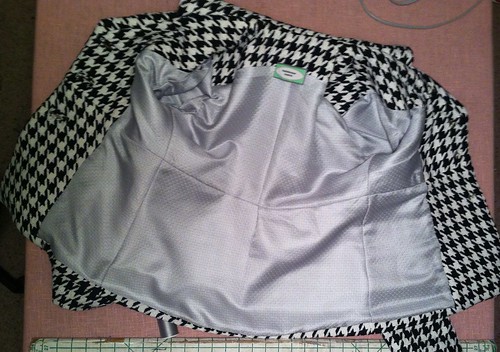
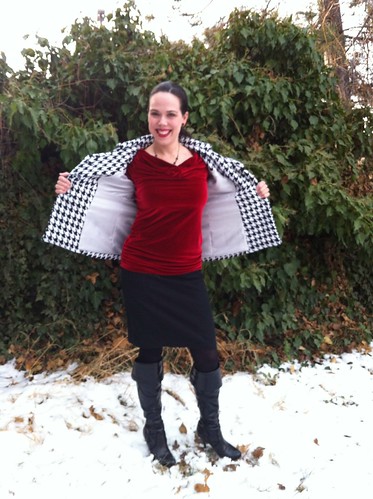
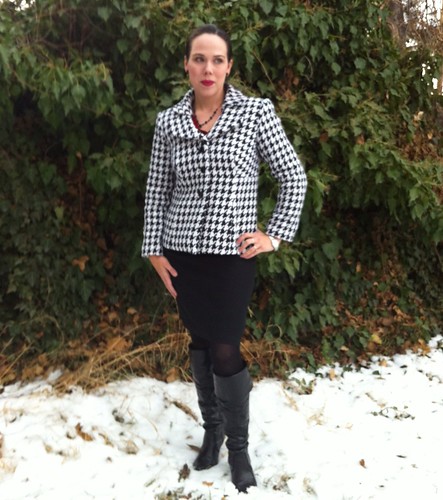
Lining any garment makes it more luxurious to wear, easier to put on and lengthens it's life. Nowhere is this more important than in a jacket or coat, where the garment is pulled over clothing several times a day and often the wrong side is seen. A lining also covers up the inner evidence of your tailoring work, leaving a clean and beautiful inner finish. Lining a jacket isn't difficult, but it does require some pattern preparation as well as some additional sewing.
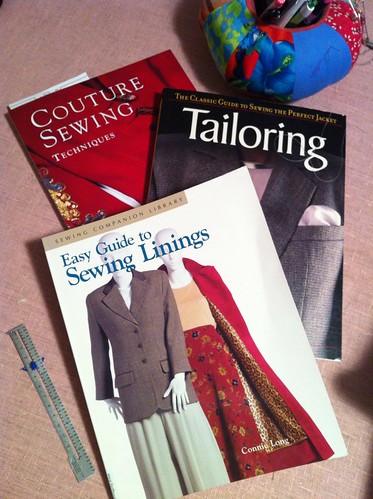
My lining was inserted using a modified hand technique, which you can find in Connie Long's Easy Guide to Sewing Linings. This book would make it on my Take to a Desert Island short list (right after the Reader's Digest Guide to Sewing). It covers lining techniques for nearly any garment you can imagine, starting with drafting you lining pattern and going all the way to finishing techniques. The Tailoring book I referenced yesterday also has a brief discussion of linings, but this is much more step-by-step. Essentially, the lining is assembled and attached to the facings by machine, then hand sewn at the hems. The finish is beautiful, and it is surprisingly easy to do.
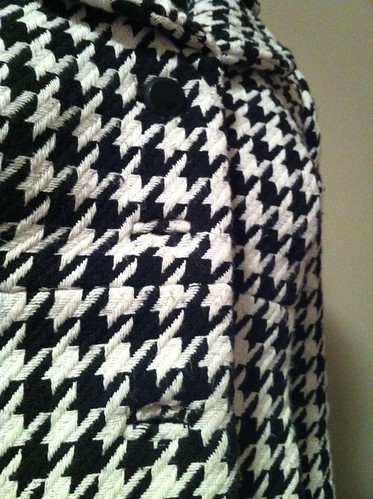
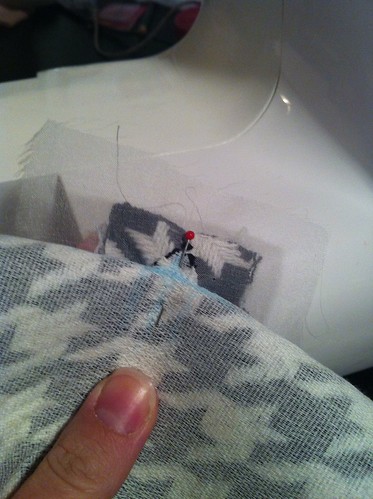
Another beautiful finish you can add to your garment is bound buttonholes. They look very intimidating, but are also surprisingly easy to make, after a little practice! I made 3 sample buttonholes before I was ready to actually cut (gasp!) my fabric. Gertie's Bound Buttonhole tutorial was what I used to make my buttonholes. The only thing I would add to her tutorial would be my hint for getting your welt lips to be evenly positioned within your window.
After slipstitching the welts in place, I would still get a little bit of slipping, but by placing a single pin through the point of my clipped triangle and pinning between the lips, they stayed centered every time.
I hope this little series has helped you to be a little more comfortable with tailoring and coat making if you weren't before, or has added a little to the knowledge base that you have. I am so happy that I finally sewed my own coat. It is beautiful and fits me perfectly, which I know I would never have been able to find off the rack.
Tailored clothing has been shaped by a variety of techniques involving everything from interfacing to hand sewing. I know as a new sewist, I was very intimidated by these techniques, but there are a lot of resources out there to help you learn them.
Here are some of the books that I used in tailoring my coat. All of these were useful to me in some ways, although if you only have Tailoring:The Classic Guide to Sewing the Perfect Jacket, you'll have what you need. This book takes you step-by-step through the process of making a beautifully tailored jacket using hand, machine and fusible tailoring techniques, which you can mix and match to meet your needs.
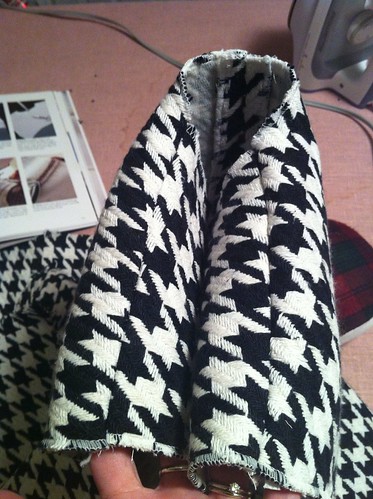
Here is the coat sans lining so that you can see the structural components that I included in the body of the coat. I used a combination of fusible interfacing to block fuse the bodice. I machine stitched on my hair canvas chest piece, but hand sewed the taping on the roll line (which in my case was also the neckline seam).
The undercollar (and the lapel facing, although that is not pictured here) were interfaced with hair canvas and padstitched by hand. Although there are machine and fusible methods for shaping the undercollar, I really think that you can't beat the shape you get by hand tailoring here. This was one of the things that really put me off of had tailoring a garment though. I was afraid of the padstitching! Once I saw it done in person, though I realized that it was easier than I was making it out to be. I wish I could come and padstitch with each of you, but since I can't, I made a video so that you could see what it looks like.
Once all the stitching is done, you can see the shape that it gives the undercollar.
See how much structure it has? That curved shape will allow it to lay close to the body and maintain its shape.
After your padstitching is done, you want to steam your undercollar into shape around your tailor's ham. You just pin it on, with the stand folded down along the roll line and blast it with your steam iron until it is damp. You will then want to let it completely dry, so set it aside and work on something else.
Another useful technique that I used on this coat was catchstitching the seam allowances by hand. In this bulky coating, it really helped control the loft of the fabric to give a really precise and flat seam.
Can you see the difference? These are the shoulder seams of the coat. Both seams have been sewn, pressed and steamed, but the seam on the left has also been catchstitched in place. See how much smoother and flatter it lies? It was a bit time consuming, but I think the results were worth the effort.
Obviously, one blog post won't teach you everything you need to know about tailoring, but if you are interested in learning more, I highly recommend the book I referenced above as well as a few blogs that I found useful:
Made By Hand - The Great Sartorial Debate - This is a wonderful blog, written by a professional tailor. He showcases his own amazing work as well as taking apart bespoke garments to examine. Fascinating! Sherry's RTW Tailoring Sew Along - A collection of tutorials to help achieve a high-end RTW finish to your tailored garments. The focus is on industry secrets, many techniques are by machine rather than hand. Gertie's Lady Grey Sew Along - Gretchen, of Gertie's New Blog For Better Sewing, takes us along as she hand tailors her Lady Grey coat. She has tons of tips, tricks and great tutorials.
Tomorrow I'll talk about a couple of finishing touches - lining your jacket and making bound buttonholes. Stay tuned!
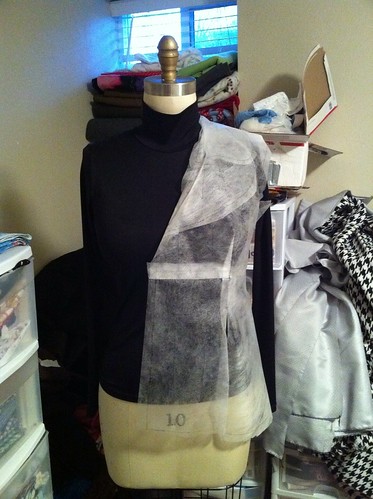
The first step in any sewing project is to get a perfect fit. If you aren't happy with the fit of your garment, then you have wasted your own time, money and fabric! This is a lesson it took me a lot of time (and wasted fabric!) to learn, but I know that spending a little time getting the fit just right before you cut your fabric will save much pain and suffering later. I always start by tissue fitting my pattern on my dress form to see if I need to make any major changes.
I trace all my patterns onto tracing medium (Soil Separator paper is my personal favorite), then sew it together to see how it looks. You can just cut out your pattern tissue in your correct size and pin it together on the seamline as well. After making any major changes to the tissue pattern, I cut out a muslin. Now, I don't always muslin every pattern, although there are certainly sewists who do. For this project, since I knew I would be putting a lot of work into it, I wanted to get the fit absolutely perfect before I cut into my precious coating.
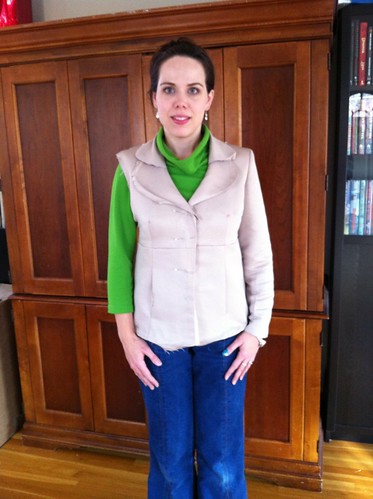
My first muslin wasn't too bad, particularly since I had already fixed the swayback in the tissue. In the heavier fabric I used for my muslin, it was clear that I needed a little more room in the bust,
As well as some additional ease across my broad back. After a 3/4 inch FBA and a 5/8 inch broad back adjustment, I made a quick bodice only muslin to check the darts and alignment. I also tried out gathers in place of the darts, which didn't work at all, so I'm glad I muslined it first. After finalizing the dart placement, I sewed muslin #3.
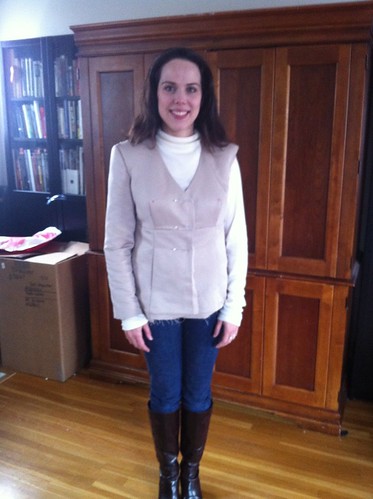
And it worked! I'm happy now with the dart placement and the amount of ease in the bodice.
In back, the adjustment there gives me enough ease to move, without being to large. You can see on the sleeveless side, I tried a shoulder dart, but didn't like the way it looked, so I ended up easing the back shoulder (which I had lengthened with my broad back adjustment) into the front. One thing to remember is that even if you don't think you'll need to adjust the sleeve, you need to set them in to make sure that the back of your garment fits well, as the sleeve effects the fit there.
So in the end, I only had to make a few adjustments to this pattern and they were all pretty standard adjustments for me. I did a small FBA, a broad back adjustment and a small swayback adjustment.
The Perfect Fit: The Classic Guide to Altering Patterns - This book has great fit methods, but is often a little light on the explanations. I wouldn't use it as my primary fit resource, but I've learned a lot from it about alternate ways to fit a garment. It is particularly helpful in "non-standard" situations.
Fast Fit by Sandra Betzina - This book helps "diagnose" fit problems by focusing on how an ill fitting garment might appear and what the problem is. Her fit solutions are good, although they don't always apply to every situation.
Debbie Cook's FBA tutorials - Debbie taught me how to do an FBA! I cannot recommend her tutorial's highly enough. They are clearly written and easy to follow. She covers how to do and FBA for many different situations, such as on a dolman sleeve or a twist top.
Sigrid's Sewing Tutorials - Sigrid has collected many sewing tutorials from all over the web and collated them into one blog. Very helpful!
I hope this is helpful. Tomorrow I'll chat a little about tailoring. Stick around for that!
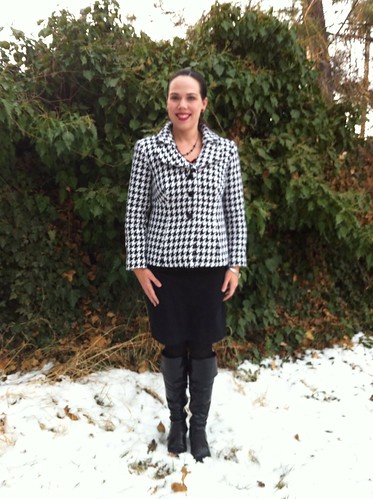
It seems like this has been the season for the coat in blogland. Did you see Karen's? Wow. Or Kristine's? A-MAY-ZING! I've been thinking about sewing a coat for some time, but between fear of tailoring and living in Texas, it hasn't happened until now.
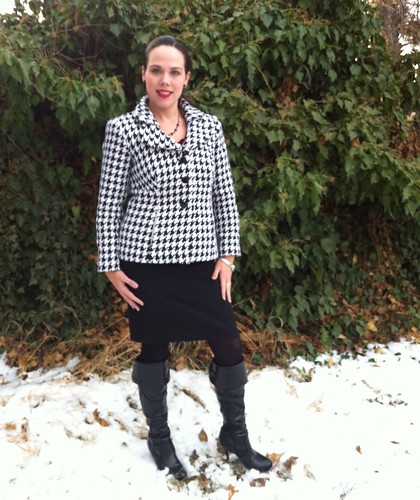
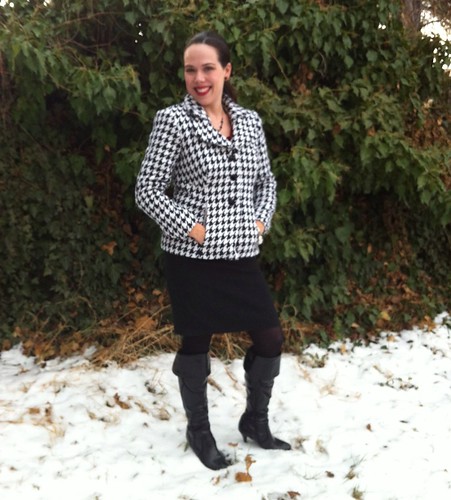
I'm really more of a jacket length kind of girl, so I decided on Simplicity 2256 as my pattern. I fell in love with this style as soon as I laid eyes on it. I love the curved, layered collar, the empire line and the simplicity of style. I think it has a nod to a vintage look, without actually feeling like it came from a particular era.
And look - pockets! I love these sneaky little in-seam pockets. The pattern was a pleasure to sew - beautifully drafted and well fit. The instructions were good and although I generally find that Project
Runway patterns can be a little difficult to follow, as they can jump around a
little, this one wasn’t that way at all. I had no trouble following it. I did
mark the instruction sheet to make it easier to follow the components that I
was including.I'll talk more tomorrow about the few fit changes I made, but they were minor and typical for me. I only had 2 issues with the pattern. The first was that it is unlined. Truly, if you saw this jacket/coat in a shop and it wasn't lined, you'd never buy it.
I did draft a lining for it, of course. It would have been nice to have one included. My other complaint was the pocket bags. Then pattern only includes one size piece for the pocket bags, and it is miniscule. Admittedly, the size of the pocket is limited by the size of the lower front panel, but the included pattern piece was just silly small. I don't think you could even fit your keys in there, much less your entire hand. I enlarged the pattern piece to fit within the front panel, and it is just the right size for my keys on one side, phone on the other with just enough space to keep my hands toasty too.
The fabric is a heavy wool coating from Hancock's. I absolutely love it and have been hoarding saving it for about 2 years. The lining is a silver brocade that came from a Fabric Mart mystery bundle. It acts like polyester, but is fairly heavy, which was a good pairing with the heavy coating.
There is a lot more to say about this coat, and tailoring in general, so I'm going to spread it out over the next 3 days. Tomorrow we'll talk about fit, tissue fitting and muslin making, then I'll discuss structure and shaping with some tailoring techniques (and a video - don't miss it!), then I'll discuss a couple of finishing touches - bound buttonholes and lining.
If you've come by from Simplicity's Facebook Fan Page - Welcome!! I'll be posting to the Fan Page with little tips throughout the next few days, as well as answering any questions. If you don't already "Like" Simplicity on Facebook, you are missing out on some serious fun, sew alongs and a great community! Click on over to their page now!