So, here they are; two tee shirts, both made with McCalls 6612. For the top on the right, I started, as a beginning sewist might, by measuring my full bust and selecting my size based on that. For reference, my full bust is 38 inches, which put me in a size 16, which I sewed faithfully. The top on the left was made using the size and alterations that I typically make when I sew Big 4 patterns. Using my high bust of 33 to select a size would have had me in a size 12, but given that I prefer negative ease in a knit top, I began with a 10 in the shoulders. I tapered out to a 12 below the armscye in back and in front actually did my usual "Cheater knit FBA" by blending back out to the 16 at the bust area, then back down to the 12 for the waist and hips.
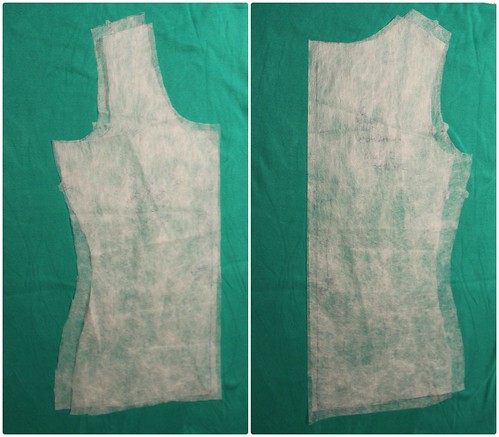
Here are the resulting pattern pieces. You can see that while the differences look slight in pattern paper, they add up to a much altered fit. In the photo, the straight size 16 is on the bottom with the altered 12ish on the top.

The other thing I wanted to look at was the methods used in constructing the top. For the size 16, I followed the McCalls instructions to the letter. I'm not going to lie, y'all. That was hard for me to do. The edges are all finished with a double fold narrow hem, stitched with a single line of straight stitching. Inside, the seams are also seamed with a straight stitch, although a double row of stitching is done here. You can see from the upper right picture of the hem how badly this fabric rippled during hemming. It isn't as obvious on the neckline, but it is significantly stretched out of shape. the seams inside don't look too dreadful though, and at least they had me trim them.

Here is how my top went together. I used my coverstitch machine to do a single fold hem. A twin needle would have worked just as well and reduced the likelihood your hems would stretch out of shape. For the neckline, I was trying to preserve the look of the original top. I used clear elastic to stabilize the neckline edge. By serging it on slightly stretched, it prevents the neckline from stretching out during sewing. I turned under a single fold hem and topstitched with a regular straight stitch, but set to a longer stitch length to give it some flexibility. Inside the tee, I serged my seams with a 3 thread stitch. A stretch stitch or narrow zigzag on a regular sewing machine would have done well here also.
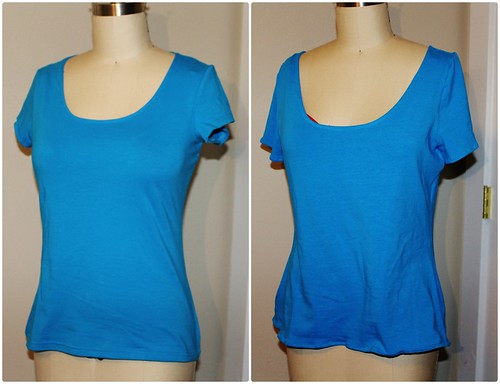
We began this discussion with the topic of fit. The question that remains - Is the Big 4 fit model outmoded? Should she be changed? If you look at the tee shirts on the dressform, it seems obvious that something is wrong here. If I was learning to sew, I might have tossed in the towel after the fail on the right. But just because the Big 4 doesn't fit my full busted figure well, it doesn't follow that the fit model is at fault.

Had I started with my high bust measurement, the shoulders wouldn't have been massive. The top would have been snug in the bust, but would otherwise have fit reasonably well. I know several people responded, either here on on Twitter or Facebook that they actually got a really great fit with Big 4 patterns, using a minimum of alterations. I know for myself, I've gotten comfortable enough with the Big 4 draft that I know generally what alterations I will need, and can make them on the tissue pattern as I trace. A new fit model would mean that those of us that are comfortable with the Big 4 draft would have to learn an entirely new set of alterations. Something to consider, to be sure.

So, what about construction methods? That gaping, rippling neckline isn't just a fit issue. A double fold, straight stitched hem on the neckline of a knit top is a recipe for disaster. My understanding is that the Big 4 uses a standard block of instructions that are cut and pasted into each pattern depending on what garment is being made. Patterns are developed, printed and sold quickly and there is apparently no opportunity to test them. That said, I feel that even within this framework, there are changes that need to happen, particularly in the basic block of instructions for a knit garment. Given the fabrics, materials and machines that are available for us to work with, it is asinine that the pattern instructions are as outdated as they are.

So, what do you think needs to happen? Are you down with the fit model? Do you think the instructions need an overhaul? Are you over the Big 4 totally and just sticking to independent patterns that you know you can count on? Talk to me!